Permissionless L1s Staking Manager Operations Lesson 1 of 10
Introduction
Learn about the staking operations available for managing validators and delegators in a Permissionless L1
This chapter covers the end-to-end validator and delegator lifecycle on a permissionless L1 managed by the StakingManager contract (via either NativeTokenStakingManager or ERC20TokenStakingManager). We will learn all of the operations available, understand the theory, and demo them using the Toolbox:
- Register a validator (stake tokens, register on P-Chain, complete on L1)
- Delegate to a validator (stake tokens, update weight on P-Chain, complete on L1)
- Remove a validator (initiate removal, update weight on P-Chain, complete removal + claim rewards)
- Remove a delegation (initiate removal, update weight on P-Chain, complete removal + claim rewards)
PoA vs PoS Operations
If you've completed the Permissioned L1s course, many of the flows will feel familiar. The key differences are:
| Aspect | Permissioned (PoA) | Permissionless (PoS) |
|---|---|---|
| Who can add validators | Only the contract owner | Anyone who stakes enough tokens |
| Staking requirement | None (weight is assigned) | Must lock tokens as stake |
| Delegation | Not supported | Supported (delegators earn rewards) |
| Validator removal | Owner-initiated only | Owner of the validation period can remove |
| Rewards | None | Uptime-based staking rewards |
| Weight determination | Manually set by owner | Proportional to staked tokens |
Key Concept: The 3-Phase Pattern
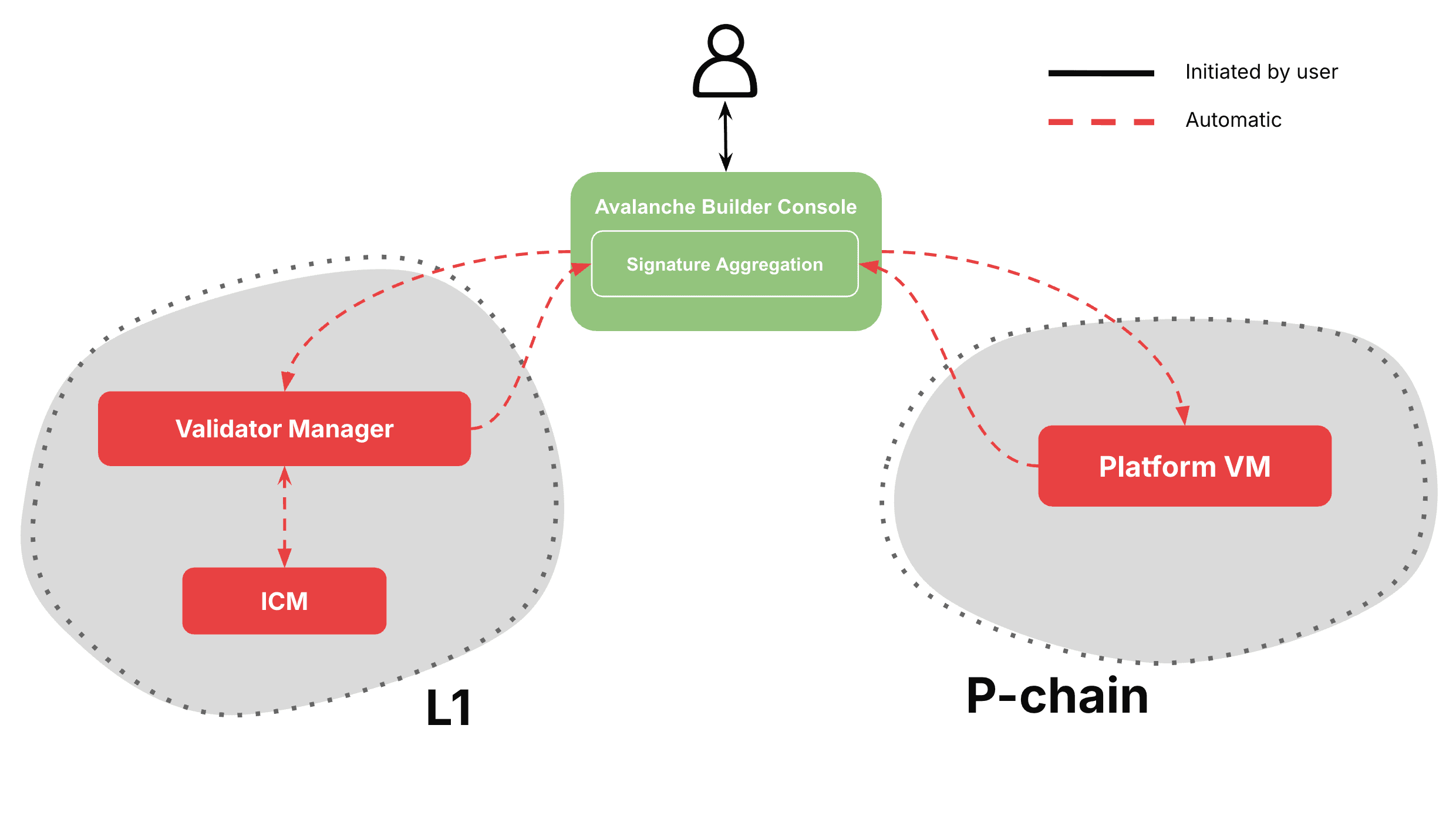
All staking operations follow the same three-phase communication pattern between the L1 and the P-Chain:
- Initiation (L1) - Call a function on the Staking Manager contract, which locks tokens and emits a Warp message
- P-Chain Processing - Aggregate signatures and submit the transaction to the P-Chain
- Completion (L1) - Call a completion function with the P-Chain's signed response to finalize the operation
Key Concept: Staking Rewards
Unlike permissioned L1s, permissionless L1s distribute staking rewards based on validator uptime:
- Validator rewards are distributed when the validator is removed via
completeValidatorRemoval - Delegation rewards are distributed when the delegation is removed via
completeDelegatorRemoval, minus a delegation fee paid to the validator - Delegation fees accumulated by validators are claimed separately via
claimDelegationFeesafter the validation ends - Rewards are calculated by the RewardCalculator contract, which you deployed during the Staking Manager Setup
Is this guide helpful?